In food manufacturing, personal hygiene rules are often very clear.
Watches are not permitted in production areas, personal belongings must be left in designated areas, eating is allowed only in specified locations, and personal medication must be controlled. In higher-hygiene areas, even external pockets on workwear may be restricted.
Such rules are hardly surprising. They are simple, easy to understand, and serve a legitimate purpose – reducing the risk of product contamination.
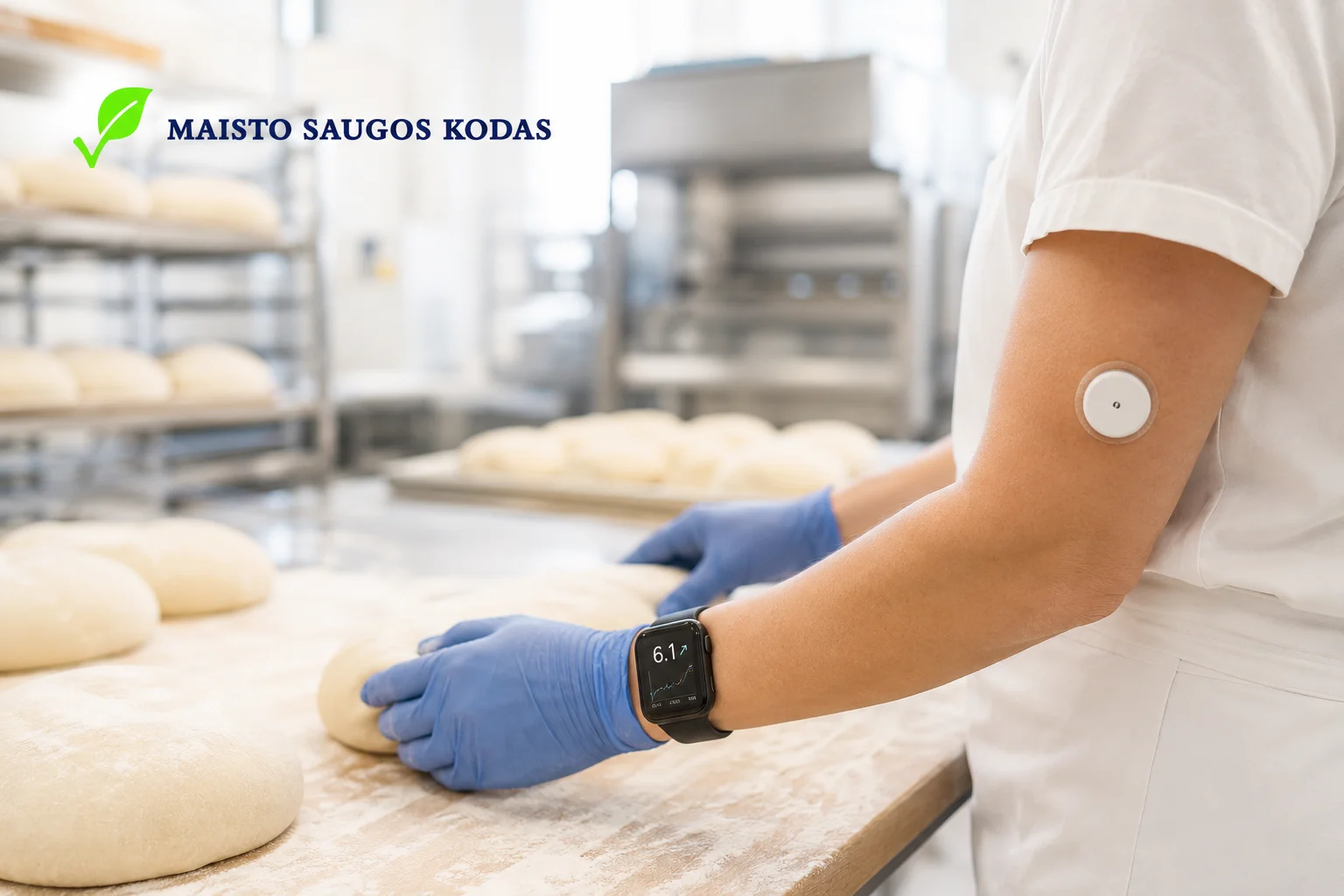
But what if an employee has diabetes and uses a smartwatch to monitor their blood glucose levels?
To someone unfamiliar with diabetes, the watch will probably still look like just a watch. Yet diabetes management is one of the areas in which medical technology has advanced significantly in recent years. Blood glucose levels can be continuously monitored using a sensor attached to the body – a continuous glucose monitor (CGM) – with the data displayed on a smartphone or smartwatch, while insulin can be administered using an insulin pump or smart insulin pen.
This means that an item which, under a general hygiene rule, would be regarded as a personal electronic device may also serve a medical function for a particular employee.
Should the rule change in such a case? And if so – to what extent?
Food safety standards already provide for exceptions
Interestingly, international food safety standards do not entirely ignore this issue.
IFS Food 8 takes a risk-based approach to personal hygiene requirements. Visible jewellery and watches must not be worn, but the same requirement allows for exceptions – provided they are comprehensively evaluated through risk assessment and effectively managed.
BRCGS Food Safety Issue 9 is even more specific. Its Interpretation Guideline states, in relation to personal medication, that wherever possible it should not be taken into production areas. At the same time, however, it explicitly recognises situations where an employee needs to keep medication with them for medical reasons. Diabetes and asthma are specifically mentioned as examples. In such cases, procedures must be established to control the medication, taking into account its form and packaging.
BRCGS also provides for another medical exception. Although the wearing of jewellery is restricted, medical alert jewellery – for example, indicating epilepsy or an allergy – may be worn provided it does not pose a product contamination risk.
The requirements applicable to FSSC 22000 v7 follow a similar principle: where a particular personal item cannot be removed, it must be appropriately covered or otherwise controlled so that it does not pose a product contamination risk.
The concept of an exception, therefore, is not unfamiliar to food safety standards. IFS links it to risk assessment, while BRCGS explicitly recognises certain medical needs.
But what does a justified exception look like in a real production environment?
When one exception requires another
Diabetes provides an interesting example because a single medical need may affect several different food safety rules at the same time.
CGM data may be monitored on a smartwatch or smartphone, even though personal electronic devices are normally restricted in production areas. And in the event of hypoglycaemia – an excessively low blood glucose level – an employee may need to consume a glucose tablet immediately in an environment where eating is normally prohibited.
The example of glucose illustrates how quickly a seemingly simple exception can turn into a chain of decisions.
Suppose a company assesses an employee’s medical need and allows them to have immediate access to glucose tablets while working in the production area.
The issue would appear to be resolved.
But where should they be kept?
If the employee’s workwear has a suitable pocket, one possible solution would be to keep the glucose there. However, in certain production areas, external pockets on workwear are deliberately avoided or restricted to reduce the risk of foreign-body contamination.
So we have made the first exception – we have allowed the employee to have glucose tablets.
Do we now need a second exception – allowing them to keep the glucose in a pocket?
And if the employee develops hypoglycaemia and needs to consume a glucose tablet immediately, do we need yet another exception to the rule prohibiting eating in the production area?
Perhaps the glucose could be kept in a designated, easily accessible location. But how far away from the employee can it be before access is no longer sufficiently rapid? Should the employee first leave the production area and only then consume it? And what if their condition has already deteriorated to the point where safely leaving the area is not the best option?
How many exceptions are needed for one medically justified exception to actually work in practice?
At this point, it is no longer enough to include a single sentence in a procedure stating that exceptions may be made for medical reasons. A decision is needed on how those exceptions will actually work in a real-life situation.
A similar principle can be seen in an entirely different field – professional sport. Tennis player Alexander Zverev, who has type 1 diabetes, has been granted exceptions during tournaments that allow him to manage his diabetes during matches, including monitoring his glucose levels and using insulin. At Wimbledon, he was permitted to use his phone to monitor his glucose data.
What is interesting here is not the tennis itself, but the principle: an exception does not remove the purpose of the rule. It may change the way in which that purpose is achieved.
An exception does not mean the risk has disappeared
A smartphone does not stop being a smartphone simply because it displays CGM data.
A smartwatch does not stop being an object worn on the wrist.
And glucose packaging may still pose a product contamination risk.
The medical function does not eliminate these risks.
A medical need, therefore, should not automatically mean either “permitted” or “our rules prohibit it, so it is not allowed.”
Perhaps the first question should not be what exception the employee should be granted, but rather which medical function must be preserved.
Does the employee need to see their glucose readings continuously, or are alerts about dangerously falling glucose levels the critical function? Do glucose tablets need to be carried on the employee, or could they be stored in a quickly accessible location? Can a particular medical device be safely covered by workwear? Is there another solution that preserves the medical function while presenting a lower risk to the product?
The same need – a different risk
A risk-based approach also means that the same medical need does not necessarily have to result in the same solution throughout the entire facility.
Imagine an employee who monitors CGM data on a smartphone or smartwatch and works in a warehouse containing sealed finished products. Now consider another employee with exactly the same medical need who works next to exposed ready-to-eat product in a high-hygiene or high-risk area.
The medical need is the same. The device may be the same.
The product risk is not.
In the warehouse, it may be sufficient to establish specific rules for the use, storage and hygiene of the device. In a production area with exposed product, additional controls or an alternative solution may be necessary.
The same applies to glucose tablets. At one workstation, keeping appropriately packaged glucose in an employee’s pocket may not pose a significant risk to the product. At another, a designated storage location that remains quickly accessible to the employee but is outside the immediate product area may be a more appropriate solution.
This is precisely why a risk-based approach is not a universal table of exceptions.
So where should the line be drawn?
If one medically necessary exception requires a second exception in order for the first one to work in practice – should we make it?
And what if it requires a third?
Where is the line between a justified individual solution and a situation in which there are so many exceptions that established food safety controls begin to lose their effectiveness?
There is probably no single answer that will be appropriate for every company, product and production area.
But this is precisely where it is important not to confuse a risk-based approach with justification of an exception.
A risk assessment should not be a document written after the decision has already been made to allow something. Equally, it should not be used to justify an absolute prohibition that has already been decided upon.
The outcome may differ from case to case. In one situation, the result may be permission subject to additional controls. In another, the conclusion may be that an exception would create an unacceptable product risk in that particular production environment and that an alternative solution must be found.
Perhaps this is why the strictest rule is not always the best risk management solution. But equally, a medical need is not in itself a reason simply to set a food safety rule aside.
The key question, therefore, is not whether exceptions should be permitted, but how we determine when an exception is justified, what form it should take, and where its limits should lie.
Of course, whether an employee with a chronic medical condition can work in a particular role is not solely a food safety matter. It may also involve occupational health and safety, medical fitness for work, the employee’s individual needs, and other considerations. The final decision may therefore be considerably more complex. This article deliberately considers the situation from one professional perspective only – food safety.
And yet, when food safety meets a medical need, we do not always have to choose one over the other.
References
- International Featured Standards (IFS). IFS Food Version 8 – Standard for auditing product and process compliance in relation to food safety and quality.
- BRCGS. Global Standard Food Safety, Issue 9 ir Food Safety Issue 9 Interpretation Guideline.
- American Diabetes Association Professional Practice Committee (2026). Diabetes Technology: Standards of Care in Diabetes—2026
- Sharpe, K. (2026). Why is Zverev allowed to use his phone at Wimbledon? BBC Sport