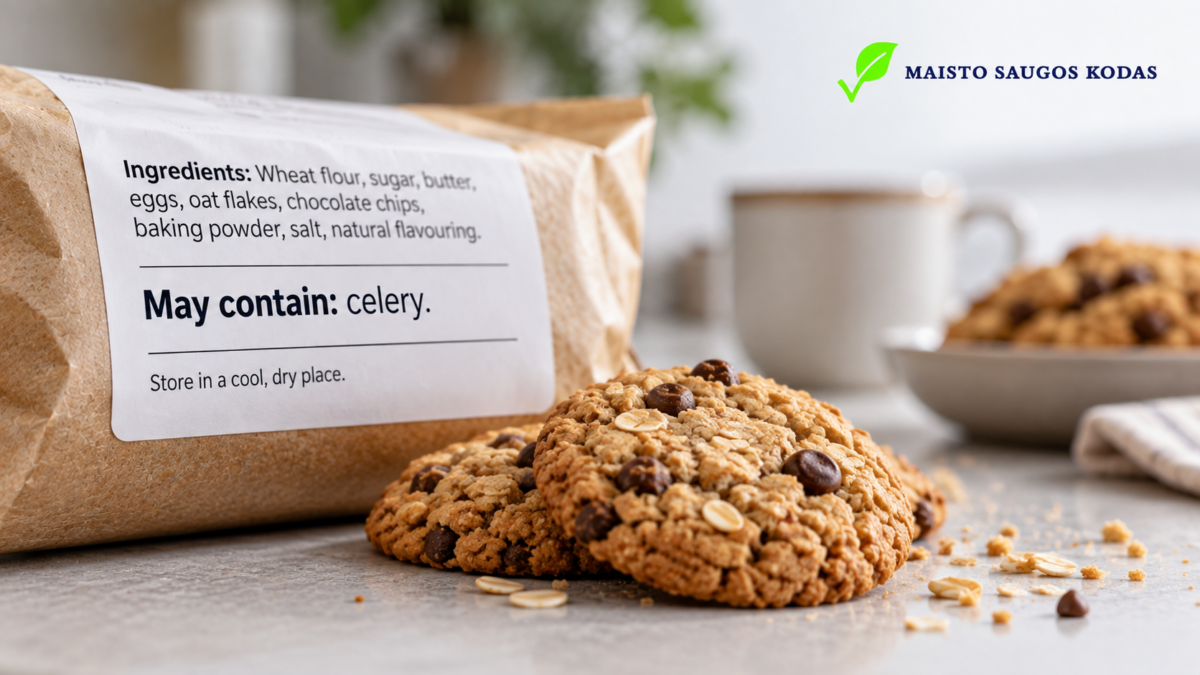
Pick up a packet of biscuits and read the allergen information. Milk, eggs, nuts – none of these would be particularly surprising in baked goods. But what would you think if you found a warning stating that the biscuits may contain traces of celery?
I have seen a label like that.
Perhaps celery is used in another product manufactured in the same production environment. Perhaps the warning originated from the specification of one of the ingredients. Or perhaps the manufacturer simply could not confidently rule out the possibility of cross-contact and chose what seemed to be the safest option – adding another allergen to the precautionary allergen labelling.
From a food manufacturer’s perspective, the logic is understandable. If I cannot guarantee that the allergen is absent, perhaps it is better to warn the consumer?
But now consider the same label from the perspective of someone with a food allergy.
Every additional “may contain…” statement may mean one more product they choose not to buy. If precautionary allergen labelling is used without assessing the actual risk, simply “just in case”, the range of foods available to an allergic consumer may be unnecessarily restricted.
Excessive use of PAL (Precautionary Allergen Labelling) has another consequence. When the same warning is used both where there is a significant risk of allergen cross-contact and where the possibility is very low or merely theoretical, it becomes increasingly difficult for consumers to understand what the warning actually means.
This raises a question that is not as simple as it may first appear:
Are we really protecting allergic consumers in the best possible way if, as a precaution, we simply tell them to avoid more and more products?
When “Present or Absent” Is No Longer Enough
I first encountered a different approach to this problem in practice around eight years ago, while working in food manufacturing.
One of our customers in the Netherlands required a quantitative allergen risk assessment using the VITAL® methodology. At the time, this was a new area for me and one that required much deeper understanding, so a colleague and I travelled to the Netherlands to attend in-person VITAL training.
Even then, the Netherlands was one of the European countries where quantitative approaches to allergen risk assessment were relatively advanced. But what stayed with me most from that experience was not the methodology itself or a particular calculation.
What fascinated me was the logic of quantitative risk assessment itself.
It is very easy to reduce allergen cross-contact to a binary question: the allergen can be present or it cannot. There is a risk or there is not. Label or do not label.
Quantitative allergen risk assessment (QRA) looks at the same problem in greater depth.
If an allergen can unintentionally enter a product, the next questions are: how much could be present, what dose could the consumer receive, and could that dose trigger an acute allergic reaction?
VITAL was my first practical introduction to this way of thinking. It is an allergen risk assessment programme developed by the Allergen Bureau in Australia and New Zealand to help food manufacturers assess unintended allergen presence resulting from cross-contact and support decisions on precautionary allergen labelling.
But VITAL is one specific methodology. QRA is a much broader approach to risk assessment.
And it is about much more than a calculator or a formula.
How Much Is Actually “Too Much”?
Suppose laboratory testing detects 10 mg/kg of allergen protein in a product.
Is that a lot?
We cannot answer that question from the concentration alone.
If a person eats 20 g of the product in a single eating occasion, the allergen dose they receive will be very different from the dose received after eating 200 g of the same product. Although the allergen concentration is identical in both cases, the exposure in the second case will be ten times higher.
This is why risk assessment is not only about the concentration of allergen in the product, but also about how much of that particular food a person may consume in a single eating occasion and, ultimately, the allergen dose they may receive.
This is where allergen management begins to move away from a simple “present / absent” question towards “how much, and what does that amount mean?”
From Precaution to Data-Driven Decisions
For me, this is one of the most interesting aspects of QRA.
In food safety, it is natural to want to make the most cautious decision possible. But the most conservative decision is not necessarily the one that manages risk most effectively.
Where there is a possibility of allergen cross-contact, the easiest option may be to add another allergen to the PAL statement. But precautionary allergen labelling should not become a substitute for good manufacturing practices, appropriate control measures or risk assessment itself.
That is why QRA does not start with a calculator.
First, we need to understand where the allergen could come from. Is it used on the same equipment? Could cross-contact occur through ingredients, personnel or the production environment? Can it be prevented? What control measures are in place, and are they effective? What data do we have on the potential amount of allergen present, and how reliable are those data?
Only then do the numbers become meaningful.
This is why quantitative allergen risk assessment interests me not as a mathematical exercise, but as a way to move from “this will be safer” to a much more important question: “What data and what assessment of risk are we using to justify our decision?”
Eight Years Later, the Context Looks Very Different
When I first encountered quantitative allergen risk assessment around eight years ago, it still seemed like a relatively niche area in Europe.
Today, that is changing.
In 2026, Codex Alimentarius adopted guidelines on precautionary allergen labelling in which the use of PAL is linked to risk assessment, scientifically based Reference Doses and Action Levels. This represents an important international shift from an undefined “may contain” approach towards more harmonised, risk-based decision-making.
Change is also taking place in the European Union. The European Commission has asked EFSA to provide scientific and technical support for the further development of PAL regulation in the EU, including the scientific basis for Reference Doses and the assessment of food consumption amounts relevant to European consumers.
This does not mean that the EU already has a fully established quantitative PAL framework. But the direction of the international discussion is becoming increasingly clear: away from the mere possibility of an allergen being present and towards a risk that can be better quantified and supported by data.
Why I Am Returning to This Topic Now
I have chosen quantitative food allergen risk assessment as one of the specialist areas of Maisto saugos kodas.
Not because I believe every food safety decision can be reduced to a formula.
On the contrary – the more I work with risk assessment, the clearer it becomes that a sound decision requires numbers, reliable data, an understanding of the process and professional judgement.
In allergen management, our goal is to protect allergic consumers from real risk. At the same time, we should ensure that precaution taken “just in case” does not unnecessarily restrict their choices.
Simply knowing that an allergen could be present is not enough. The more important question is: do we have enough data to assess the risk and justify our decision? This is where QRA begins.
Eglė Valukonienė
Founder & Food Safety Consultant
Maisto saugos kodas